Mohammed and Charlemagne by Henri Pirenne
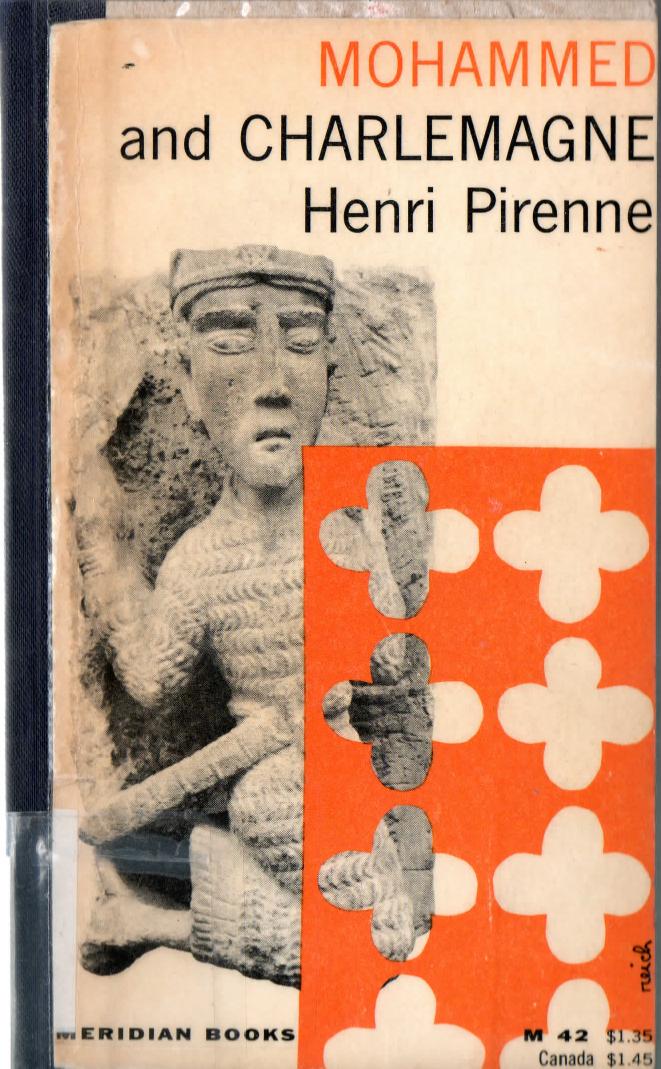
Author:Henri Pirenne
Language: eng
Format: epub, mobi, pdf
ISBN: 9780486122250
Publisher: Dover Publications
Published: 2012-07-18T04:00:00+00:00
2. The Carolingian Mayors of the Palace
In 688, then, the mayor of the palace of Austrasia imposed his tutelage on the kingdom. But he did not remain beside the king. It was enough for him that he had conquered his rival, the mayor of the palace of Neustria, and had taken his place. The affairs of the kingdom interested him only in so far as they served to strengthen his position in the North. This, for him, was the essential thing. It was threatened by the proximity of Frisia, in which paganism still prevailed, and whose prince, Ratbod, had perhaps already been encouraged to oppose Pippin by his enemies the Neustrians. At all events, the war which broke out in 689 went against him. He was defeated at Wyk-lez-Duurstete and had to surrender West Frisia to the conqueror.704 It will be understood that this victory must have increased Pippin’s prestige in every respect. It was in this country that the Anglo-Saxon Willibrord made his appearance in the following year (690), when he set to work upon the conversion of the Frisians. He was the first intermediary between the Carolingians and the Anglo-Saxon Church. The relations between these two powers were afterwards to have important consequences. A little later we find Pippin protecting another Anglo-Saxon missionary, Suitbert, to whom his wife Plectruda gave a domain, on one of the islands of the Rhine, on which he built the monastery of Kaiserswerth.705
Having conquered the Frisians, Pippin, between 709 and 712, turned upon the Alamans, who had constituted themselves as an independent duchy. He does not seem to have derived much profit from this campaign.706 He never again saw Neustria, but until his death (in December 714) he continued to retain his hold upon it by means of a representative. As a matter of fact, in 695, on the death of Norbert, he sent his own son Grimoald to Childebert II as mayor of the palace. The Carolingian family thus had entire control of the monarchy. They had it so well in hand that when Grimoald was assassinated, a few weeks before his own death, Pippin appointed, as his successor in Neustria, Theodebald, the bastard son of Grimoald, aged six.707 Thus the position of mayor of the palace was regarded by Pippin as a family possession, a kind of monarchy, parallel with the actual monarchy.
But he had carried matters too far. The Neustrian aristocrats found that they were being unduly sacrificed to the Carolingians; nevertheless, the Carolingians took some steps which were in their favour, as, for example, deciding that the Courts should be chosen by the bishops and the magnates—a step which King Dagobert III did nothing to oppose.
In 715, a few weeks after the death of Pippin II, the grandi of Neustria rebelled against Plectruda, the wife of Pippin, who, like a Merovingian queen, was acting as regent for Theodebald. This is not to be regarded as a national movement. It was merely the reaction of an aristocracy which was anxious to shake off the tutelage of the mayors and resume the direction of the palace.
Download
Mohammed and Charlemagne by Henri Pirenne.mobi
Mohammed and Charlemagne by Henri Pirenne.pdf
This site does not store any files on its server. We only index and link to content provided by other sites. Please contact the content providers to delete copyright contents if any and email us, we'll remove relevant links or contents immediately.
| Africa | Americas |
| Arctic & Antarctica | Asia |
| Australia & Oceania | Europe |
| Middle East | Russia |
| United States | World |
| Ancient Civilizations | Military |
| Historical Study & Educational Resources |
The Daily Stoic by Holiday Ryan & Hanselman Stephen(3324)
The Fate of Rome: Climate, Disease, and the End of an Empire (The Princeton History of the Ancient World) by Kyle Harper(3067)
People of the Earth: An Introduction to World Prehistory by Dr. Brian Fagan & Nadia Durrani(2738)
Ancient Worlds by Michael Scott(2688)
Babylon's Ark by Lawrence Anthony(2679)
The Daily Stoic by Ryan Holiday & Stephen Hanselman(2578)
Foreign Devils on the Silk Road: The Search for the Lost Treasures of Central Asia by Peter Hopkirk(2465)
India's Ancient Past by R.S. Sharma(2454)
MOSES THE EGYPTIAN by Jan Assmann(2417)
The Complete Dead Sea Scrolls in English (7th Edition) (Penguin Classics) by Geza Vermes(2283)
The Earth Chronicles Handbook by Zecharia Sitchin(2230)
Lost Technologies of Ancient Egypt by Christopher Dunn(2226)
24 Hours in Ancient Rome by Philip Matyszak(2084)
Alexander the Great by Philip Freeman(2065)
Aztec by Gary Jennings(2032)
The Nine Waves of Creation by Carl Johan Calleman(1918)
Curse Tablets and Binding Spells from the Ancient World by Gager John G.;(1862)
Before Atlantis by Frank Joseph(1858)
Earthmare: The Lost Book of Wars by Cergat(1825)
